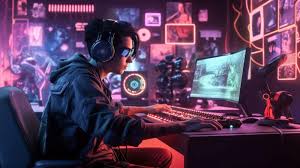
The Thriving World of Gaming: A Look at Its Impact and Future
Gaming has evolved from a niche hobby to a global phenomenon, captivating millions of people across the world. Whether it’s competitive eSports, immersive single-player adventures, or mobile gaming on the go, gaming has become a multi-faceted industry that transcends age, culture, and geography. This article explores the rise of gaming, its impact on society, and the exciting future that lies ahead for the gaming industry.
The Evolution of Gaming: From Arcades to Online Platforms
The history of gaming can be traced back to the early days of arcade machines in the 1970s and 1980s. Classic games like Pong, Space Invaders, and Pac-Man laid the foundation for the gaming industry. These games were simple yet addictive, often played in arcades that became social hubs for people looking to enjoy their favorite games.
The next major milestone in gaming came with the introduction of home consoles in the 1980s and 1990s. The Nintendo Entertainment System (NES), Sega Genesis, and later the PlayStation revolutionized how people played video games, making them accessible from the comfort of their own homes. As gaming technology advanced, so did the complexity and depth of the games themselves. Games like Super Mario 64, Final Fantasy VII, and The Legend of Zelda: Ocarina of Time became landmarks in gaming history due to their innovation in storytelling, graphics, and gameplay.
In the 2000s, the rise of online gaming began to change the landscape once again. Games like World of Warcraft, Call of Duty, and Fortnite allowed players to connect with others around the globe, marking the start of a new era of multiplayer experiences. The expansion of the internet and the rise of digital distribution platforms like Steam, PlayStation Network, and Xbox Live made it easier for players to access games, purchase downloadable content (DLC), and connect with friends for online multiplayer.
Gaming as a Cultural Phenomenon
Today, gaming is not just about playing video games—it’s a culture. The rise of platforms like Twitch, YouTube, and TikTok has turned gaming into a form of entertainment and social interaction. Streaming platforms allow gamers to share their gameplay experiences with massive audiences, while eSports has become a billion-dollar industry. Competitive gaming, where professional players and teams battle it out in games like League of Legends, Dota 2, and Counter-Strike, has gained a massive following, with tournaments filling arenas and millions of viewers tuning in online.
Gaming has also become an art form. Developers are pushing the boundaries of creativity, delivering experiences that go beyond simple gameplay. Titles like The Last of Us, Red Dead Redemption 2, and God of War have elevated the narrative potential of games, offering rich stories, compelling characters, and cinematic presentations. The increasing focus on storytelling, world-building, and character development has helped games become a respected medium for entertainment alongside film and television.
The Social and Economic Impact of Gaming
Gaming has far-reaching effects on society, from fostering global communities to driving technological innovation. Online multiplayer games have created social spaces where people can form friendships, join teams, and participate in large-scale online communities. In many ways, gaming has become a form of social networking, allowing people to connect with others who share similar interests, regardless of geographic location.
Economically, the gaming industry is a powerhouse. In 2023, the global gaming market was valued at over $300 billion, with projections indicating continued growth. The development of video games, the sale of gaming consoles and accessories, and the rise of mobile gaming have all contributed to this booming industry. Moreover, gaming has provided job opportunities not just for developers, but for marketers, streamers, esports professionals, and content creators, making it a vital part of the global economy.
The Future of Gaming: Virtual Reality and Beyond
As technology continues to advance, the future of gaming holds incredible promise. Virtual reality (VR) and augmented reality (AR) are set to revolutionize the way we experience games. With VR headsets like the Oculus Rift and PlayStation VR, players can immerse themselves in fully realized 3D worlds, experiencing games like never before. The potential for VR to create interactive and immersive environments is vast, opening up new possibilities for storytelling, exploration, and gameplay.
Moreover, cloud gaming, powered by platforms like Google Stadia and Xbox Cloud Gaming, is transforming how we access and play games. Instead of needing powerful hardware, players can stream games directly from the cloud, allowing them to play on almost any device with an internet connection.
Artificial intelligence (AI) is also playing an increasingly important role in gaming, from creating smarter non-playable characters (NPCs) to designing dynamic, adaptive gameplay experiences. The combination of AI and procedural generation is enabling developers to create vast, open-world environments that feel alive and unpredictable.